
Lessons from the Hills on Social Entrepreneurship

Updated: Mar 20
Social entrepreneurship looks poetic on Instagram (including our own account). On the ground, it looks like long walks (often uphill if you're in the Himalayas!), uncertain meetings, shifting decisions, and cups of tea that often hold more power (and sugar) than boardrooms.
During a field visit in February 2026, we were looking to begin with something small yet meaningful. At the core was a simple idea: to identify an ecological restoration effort that could strengthen the water table while belonging to the commons and the community it serves.
During an earlier visit to the same village in 2025, we had encountered a quiet but significant shift: communities moving from traditional spring water sources in the hills to water being pumped from river ecosystems. While this has fast-tracked convenience, it risks underground ecosystems and raises concerns around the long-term health implications of treated, pumped water. These reflections had emerged through our community interactions as part of a responsible tourism project, under which we are committed to integrating at least one ecological restoration effort within the same village ecosystem.

This time, we began with designing a small prototype in Sursinghdhar, Tehri, focused on tree plantation around an existing mountain spring located on Gram Panchayat land. The intention is to strengthen the local ecosystem while contributing to the long-term health of the springshed landscape.
While tree plantation is often seen as a simple activity, this effort is being approached through ecological restoration practices: focusing not only on planting trees but also on improving soil conditions and water retention so that the planted species can survive and thrive in a way that resembles natural forest systems. This effort is also envisioned as a way to build deeper relationships with the surrounding community.
With Balwant ji, our long-time guide to local knowledge and systems, we mapped constraints before mapping dreams. Private land. Forest department land. Ruled out. What remained was a modest patch below a centuries-old village well. Centrally located, accessible, and used daily by every household, it held both relevance and possibility. We called it our Potential Restoration Site.
Lesson 1: Work Within Reality, Not Romance
Every idea, no matter how well-intentioned, must pass through the filters of land ownership, local governance, and lived realities. On paper, solutions look elegant. On the ground, they must negotiate history, rights, relationships, and systems already in place.
Water surfaced again and again as the community's most immediate ecological concern, and something we could step into as a first move, to test the waters, both literally and figuratively. While working on social and ecological impact projects, there's often a temptation to go big. Big impact, big budgets, big teams, big benefits. But the waters must be tested, and interventions gradually scaled.

Working with local communities may appear romantic, but it requires trust, often more from the community's end. Many communities, especially across developing regions including India, have experienced broken promises and extractive approaches from individuals and organisations alike. Trust, therefore, takes time. And often, it needs to be mutual, to truly honour the intentions of those who wish to contribute meaningfully.
Despite the temptation to expand, we consciously chose to minimise the initial scope of work to build trust first, and then scale with confidence. Small wins matter. They build belief, strengthen relationships, and create a foundation that larger interventions can stand on.
Just like in any area of life, in social entrepreneurship, the real work often lies in holding that tension between what is urgent, and what is truly important. Choosing a 2-3 on a scale of 0-10, where 10 is the most intense (and exciting), is a skill in itself.
Lesson 2: Listen Longer Than You Speak
When we met Pradhan Babita Pundir ji, she stated something powerful: "The intention looks beneficial for the community, but let's decide this in the presence of women from the community."
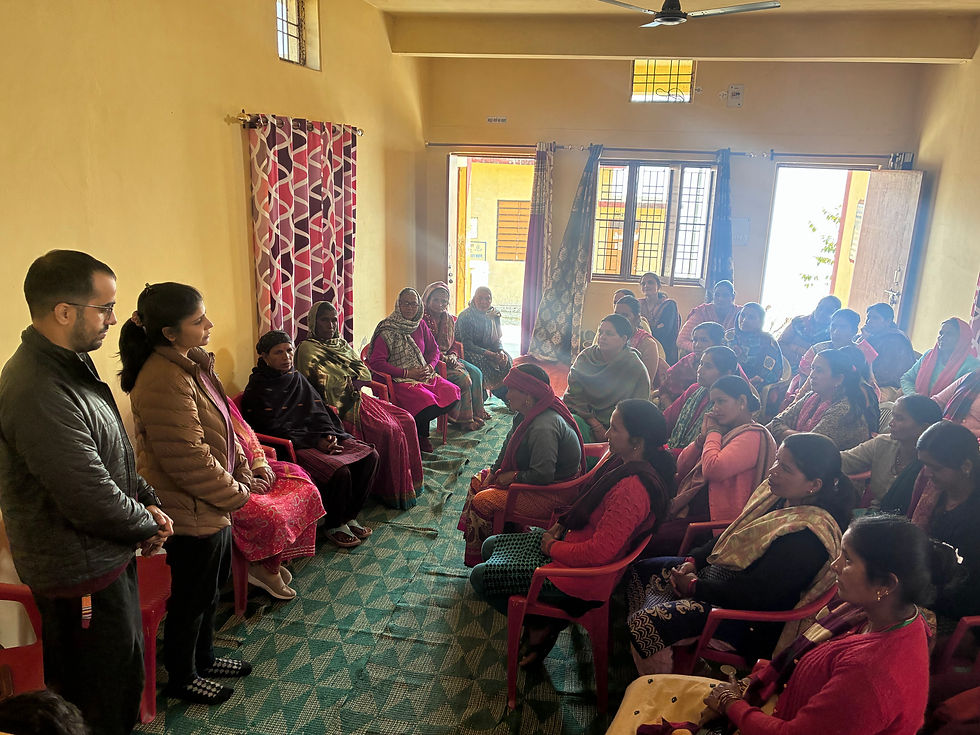
That single sentence redefined the process. True community work is not about approval, it is about participation. A sense of agency emerges when spaces are held where people can speak, question, and shape what is being built.
The next morning, in a gathering of 38 women, introductions turned into laughter, and laughter turned into ownership. Women volunteered. Offered manure. Fencing material. Even their homes for our stay. Wages were discussed openly. A core team formed organically.
For a moment, it felt aligned. And then…
Lesson 3: Expect the U-Turn
By afternoon, we learnt over a phone call from Pradhan ji that the selected site was suddenly "already approved" for a children's park. Implicit political undercurrents surfaced, decisions shifted, and a suggestion followed… to drop the idea altogether.
More often than not, we've come to realise that social entrepreneurship is not a straight line. It is a continuous negotiation with both visible and invisible forces. The governance, local dynamics, relationships, and power structures that don't always reveal themselves upfront.

Instead of reacting, we paused. Reflected. And chose to take a step back from the outcome. In that pause came a quiet but important insight that the real impact of those few days may not yet be the intervention we had hoped to initiate, but something less visible and perhaps more foundational: the trust that began to build, the youth who stepped forward with curiosity, and the women who found and exercised a collective voice.
Lesson 4: Process is Impact
The next morning, we showed up again for a conversation, a little negotiation, and chai. We carried the uncertainty with us, and chose to show up with openness.
To our surprise, a new site emerged… once again, a commons land, and within the same watershed valley we intended to centre our intervention in. This time too, the decision unfolded in the presence of community members: witnessed, voiced, and collectively held.
In community work, how a decision is made is often more important than what is decided. In staying with the process despite the uncertainty, something began to deepen. Youth started leaning in a little more, conversations became more layered, more participatory, and what began as a site visit slowly expanded into a shared inquiry.
Despite the change in the potential restoration site, we remained grounded in our core principles, and guiding values. This meant saying no to a few sites proposed the previous day which wouldn't have intersected well with all the principles in hand.

By the end of the day, as we visited nearby nurseries to identify native species for plantation, even a university partnership surfaced, opening doors for research and longer-term engagement with the university students.
The project may evolve. The site may change. The scale may shift. That is the nature of working with living systems, both ecological and human. But beneath all of this, something more fundamental had already started taking root. A way of thinking, a way of engaging, and an approach where ecology is not imposed, but co-imagined with the original custodians of it.
Moreover, it helps to see this work as a practice. More often than not, we are conditioned to treat outcomes as the only "real" work. But in journeys like these, the practice of showing up, listening, recalibrating, holding uncertainty, and beginning again is as real, and often more important than the outcome itself.
Perhaps the real impact begins with not just the restoration of land, but the restoration of relationship between people, place, and possibility.
Lesson 5: Detachment is a Skill, and an important one
We ended those days allowing our hearts to ease into uncertainty. Impact is not control; it is alignment with values while navigating complexity.

We also graciously welcomed support from community members, where those from different economic backgrounds offered to contribute in their own ways... through labour, manure, covering their stay, and other forms of support during the project.
This kind of co-creation allows us to partner with the community, rather than operate from the illusion that we are here to "empower" them.
The hills taught us that restoration begins before the first tree is planted. It begins in how we listen, how we hold resistance, how we persevere, how we stay when plans collapse, and how we begin again.
These precious lessons emerged from late evening conversations and reflections, at times with teary eyes, at others with quiet smiles, alongside my colleague Isneesh and my husband, Suhas, who was volunteering with us during the field visit.
If this resonates with you, and you'd like to learn more about our work or begin your own journey as an impact entrepreneur, feel free to reach out for a 1:1 discovery call.

Comments